It’s Day 9 of the ongoing war with Iran. With each passing day, the bloody conflict’s objectives become more muddled. Within the past week, U.S. President Trump has presented his constituency with a series of contradictory, confusing, and grossly divergent explanations behind why this mess began and when will it end. He has offered a wide spectrum of objectives including, but not limited to, paving the way for Iranians to take over their country, expressing willingness to speak to new leadership, wanting to be personally involved in selecting the next Supreme Leader, and refusing to relent on heavy bombardments until the unconditional surrender of the Islamic Republic.
There is little to no sign of political softening on the Iranian side, with officials claiming that the war will continue and the government has no intention of negotiating. While the U.S. appears to have planned or hoped for a quick and decisive victory, Iran’s military apparatus has long derived its comparative advantage on the battlefield from drawn-out and asymmetrical warfare. These competing approaches make a rapid resolution to the war unlikely. In the meantime, the cannons of war keep rumbling and the civilian toll continues to rise. Since the outbreak of the conflict on February 28, the total number of reported civilian deaths has reached 1,172, including 194 children, most of them under the age of 10.
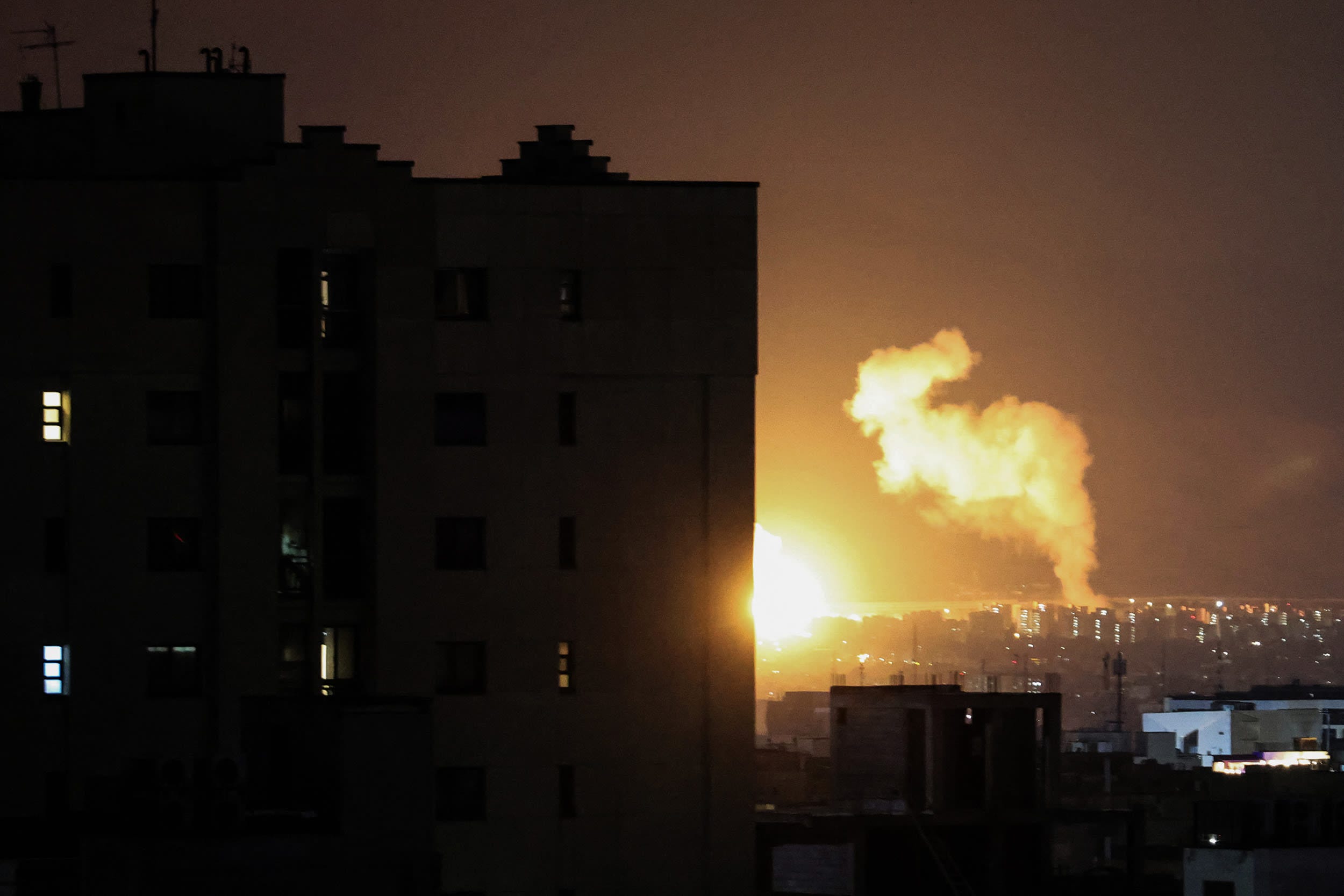
People in Tehran are talking about insomnia, panic, and exhaustion due to endless waves of strikes that have left many fearing for their lives. Particularly harrowing accounts from March 5 and March 6 suggest exceptionally terrible nights, which one eyewitness described as “hell on earth.” Numerous journalists and ordinary citizens who have managed to briefly connect to the internet amid the blackout—either through VPNs or Starlink—have described relentless thunderous explosions, buildings shaking, ubiquitous plumes of smoke, damaged infrastructures, and the destruction of military targets as well as civilian airports, oil depots, water distillation facilities, homes, and businesses.
Video: A clip circulating on social media shows a major explosion in Tehran around 3:00 a.m. on Saturday, March 7. Online reports claim the strike targeted a site believed to be linked to the IRGC Aerospace Command in the Kuhak District. Source: Vahid Online
Through all of this destruction and expanding regional insecurity, life in Washington, DC remains unchanged. Couples stroll, enjoying the mild weather of early spring. Children walk home from school, pedestrians escort their dogs to the park, and customers frequent bars and restaurants. The contrast between the harrowing accounts and images on my mind and my life in Washington is bewildering, disturbing, and at times numbing. It leaves me with a strange and distant feeling between the lived experiences of those inside Iran and the seemingly unaffected rhythm of everyday life in the capital of the nation shaping those horrors. America has once again unleashed its mighty sword thoughtlessly and with cavalier indifference while its own population remains largely untouched by the costs of war.
Observing the unchanging pace of life outside my door, I cannot help but ask myself if my neighbors even know if there is a war going on. Do they care? In their imagination, is Iran just another weird, foreign, and problematic land abroad, perpetually at war? Perhaps the news of war simply got lost in the barrage of timelines they scroll through every day? Or maybe they are simply better at compartmentalizing life than I am. There are no clear and concise answers. A truly exhaustive reply may be as difficult to come by as trying to gauge the perceptions, concerns, and private preoccupations of every individual simply hoping to get through life’s daily trials.
What I am more certain of, however, is that the distance between watching a war and living through one is immeasurable—even for the most attentive observers. So, in this post, I offer my translation of two accounts written by individuals inside Iran. As a cautionary note, I am not suggesting that these quantitatively modest accounts capture the many complex and layered worries, opinions, and visions of a nation of 90 million people. All I hope to do is provide a narrow glimpse into how some individuals inside the country are experiencing and reflecting on the war as it unfolds around them.
This effort also aligns with a broader initiative by a collective of academic scholars and observers of Iran to highlight and engage with a wider range of perspectives and analysis published from within the country. There is no need to ask permission. If you find the material useful, please feel free to incorporate it into your own work or share it more widely, as long as proper sourcing and credit are provided.
The first account is by an Iranian journalist Mohammad Bagherzadeh, who writes for the reformist newspaper Shargh. He is also a member of the International Federation of Journalists. In vivid and unsettling detail, he describes the intensity of the March 5 strikes and how he, his friend, and residents of a neighborhood in Tehran experienced what felt like a near-death encounter.
There is an important context to keep in mind before reading his post. When he refers to “soldiers,” he is speaking about young Iranian men who are required to join the military at the age of eighteen. Iran maintains a mandatory conscription system commonly referred to as sarbazi, which requires all men to serve for approximately two years. Their training begins with typical boot camp and basic combat instruction for roughly two months, after which they are assigned to various forms of service depending on their education, skills, and connections. Some become guards stationed outside banks, others work in public hospitals, and some may end up in low-level administrative roles within government offices if their skills, and a bit of luck, allow it.
As Bagherzadeh describes, during the 12-Day War and the current fighting some of these individuals may have abandoned their posts out of fear. However, doing so carries legal consequences. Under normal circumstances most conscripts are not assigned to combat roles, but the uncertainties of wartime blur many of these boundaries.
On March 6, after six days of being cut off from the internet, Mohammad Bagherzadeh managed to purchase a VPN that worked. He wrote the following on X:
The closest I’ve come to death was tonight. Around five in the morning, we had just fallen asleep when something that sounded like a fighter jet roared overheard. We were used to hearing that sound even before the war, so it wasn’t particularly unusual. But after a few minutes, suddenly the building shook, the balcony door slammed [open] into the wall and then BOOOOOM.
Everything was shaking and then again BOOOM. We were frozen.
I put a pillow over my head and we crouched in a corner, away from the chandelier and the mirror. The building was shaking violently, we could hear the sound of structures collapsing and glass shattering, and then again BOOOM. We had nowhere to go, no way forward and no way back. We kept thinking “this one must be the last,” and then an even more terrifying sound would follow.
In the middle of all those missiles, my friend said, “What if the next one hits us?” And what difference would it have made when the building was already collapsing? I don’t know after how many missiles the rhythm of the blasts stopped. A little later we heard another explosion, but this time a bit farther away. When it finally went quiet, all of us, stunned, barefoot, and terrified, rushed toward the stairwell. We were all trembling like leaves.
The dead-end alley was filled with terrified people, but the building next to ours was still intact. From a few hundred meters away, smoke and flames were rising. At the entrance to the first alley, several men in military uniforms (probably all soldiers) were panting. I remembered that two nights ago my friend who is a soldier had been trying to convince his mother why he had to stay in Tehran. He was saying that his “[legal case from abandoning duty] during the 12-Day War was still pending, and they’ve even blocked my SIM card. If I run away this time, they’ll execute me. And besides, the swollen eyes of the [other] soldiers are still on my mind. It would be heartless for me not to go, because the burden would fall on their shoulders.” The next night, though, after several barracks were struck, he was convinced and went north.
I spent the whole [June 2025] 12-Day War in Tehran. I still haven’t forgotten the terror of the last night [of that war], but last night [March 5, 2026] was completely something else compared to that war in its entirety. These days, a feeling of dread and fear is injected [to you] from every street. Even from the faces of those who have cordoned off the streets in the name of authority.
In complete silence and in this darkness, [foreign] evacuation notices are stress inducing stories. One person says [Iran] International reported this, another talks about Trump and Netanyahu Tweets calling for the evacuation of some districts. But, on state radio and television and domestic websites, there is no news at all. For many of us, if this war doesn’t bring death, it will leave us with trauma and a terrified psyche.
After six days of being cut off from the news, through a lot of trouble, I’ve now managed to buy a VPN, and I don’t even know how long it will keep working. I don’t even know which narrative [to pick] to write about these days. And I don’t know what will become of our lives or of Iran’s future. But, I hope this will be the last time these people and Iran ever experience war. I wish the shared pact among all of us would be to remove the option of war from every plan.
Smoke rises following an explosion in Tehran in the early morning hours of March 6, 2026. Photo: Atta Kenar/AFP
On March 4, 2026, Hossein Hamdieh wrote the following vignette on X. Hossein holds a joint PhD in Geography and Anthropology from Humboldt University of Berlin and King’s College London. He is currently based in Tehran, where he works as a social researcher. Through his observations at a park overlooking the city, he attempted to capture the emotional atmosphere of residents in the Iranian capital—an urban metropolis of nearly 10 million people.
Tehran is becoming Beirut. A place where war becomes part of the fabric of everyday life where people go to work, shop, and stroll while explosive fire erupts somewhere in the background of the scene.
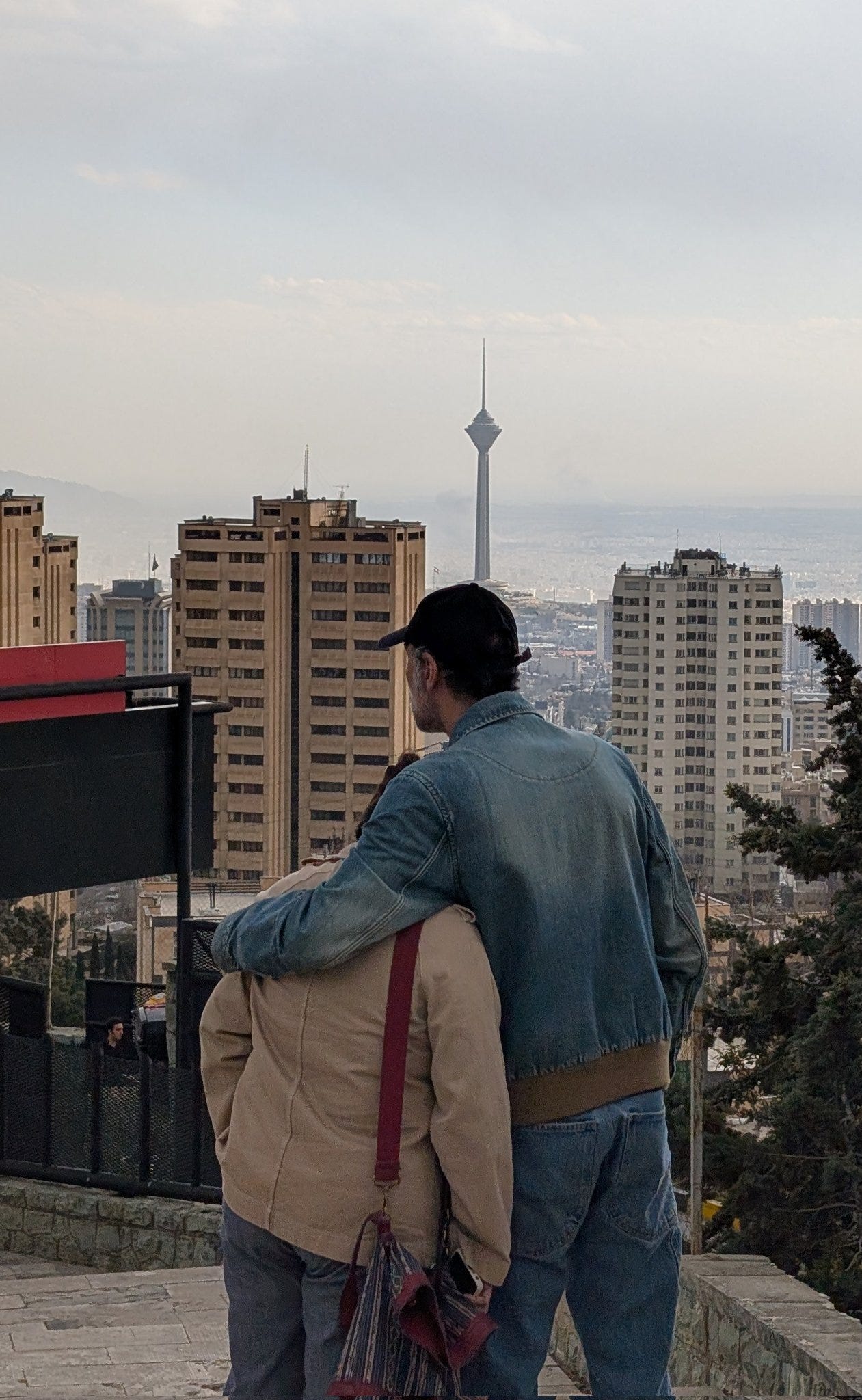
I took this photo at Parvaz Park yesterday, Monday [March 2, 2026]. People from Tehran had gathered there to look down from a high vantage point and see the destruction of the city. Fear was floating in the air, and people held their loved ones and friends, able to do nothing but “watch.” For those of you who are not here, whatever you imagine about how bad things are, multiply it by a thousand. The situation is bad. Truly bad. Dire. Hellish and full of uncertainty.
A couple watches Tehran’s destruction from above. Smoke rises in the horizon in the aftermath of a strike on Iran’s capital Tehran. Photo: Hossein Hamdieh
But life inevitably goes on. We may be the only people who can gather together and even turn tragedy into an opportunity to socialize or make jokes out of disaster. I went around the park and chatted with people. At the end they said to each other, “Stay alive.” And this might be the most concrete way to describe the reality we are living in Tehran. Don’t die. Stay alive.
What will happen? I don’t know. I have a foolish optimism that makes me think that Iran will get through this situation, lick its wounds, and continue. Just as it has always done throughout the history of this land. But what is certain is that it will be very hard for us to become the people we once were. The things we have seen. The things we have seen.
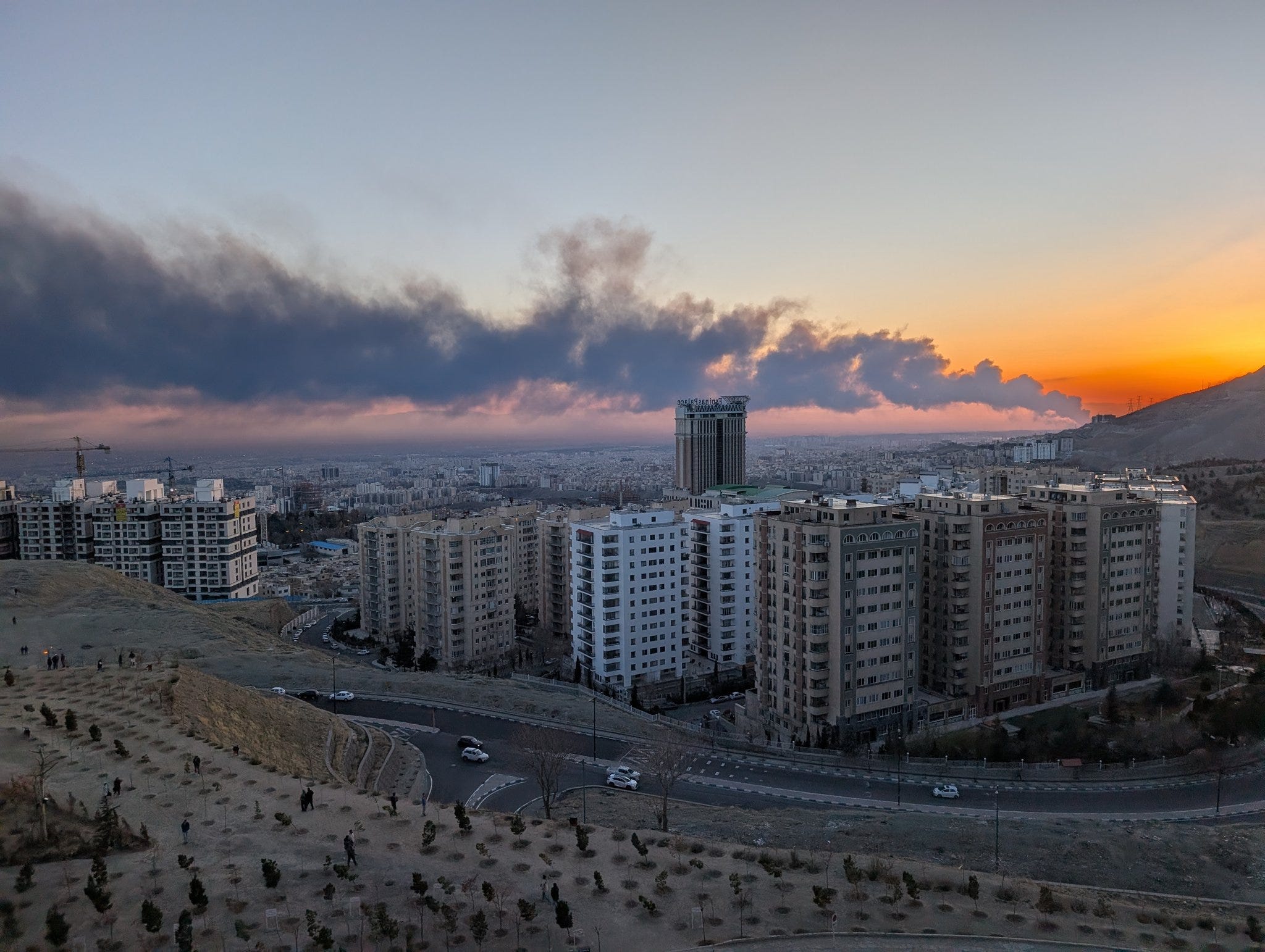
Today this city was extraordinary. Spring is coming. The air is pleasant, and Tehran, with its sorrowful beauty, is drenched in blood. We are trying to “live” despite all those inside and outside these borders who wish death upon us. I hope that even if I do not make it out of this hell, Tehran will stay alive. With its people. Because “the presence of humans is prosperity.”
[Smoke rises in the horizon in the aftermath of a strike on Iran’s capital Tehran. Photo: Hossein Hamdieh]
For more accounts and analysis from a diverse set of individuals inside the country, please see a recent post by Naghmeh Sohrabi and follow her work for both her excellent past writing and what will surely be equally valuable future contributions.
The Guarded Domains is a reader-supported publication. To receive new posts and support my work, consider becoming a free or paid subscriber.